Stay Updated
Get the best new AI tools in your inbox
Weekly roundup of the latest AI tools, trends, and tips — no spam, unsubscribe anytime
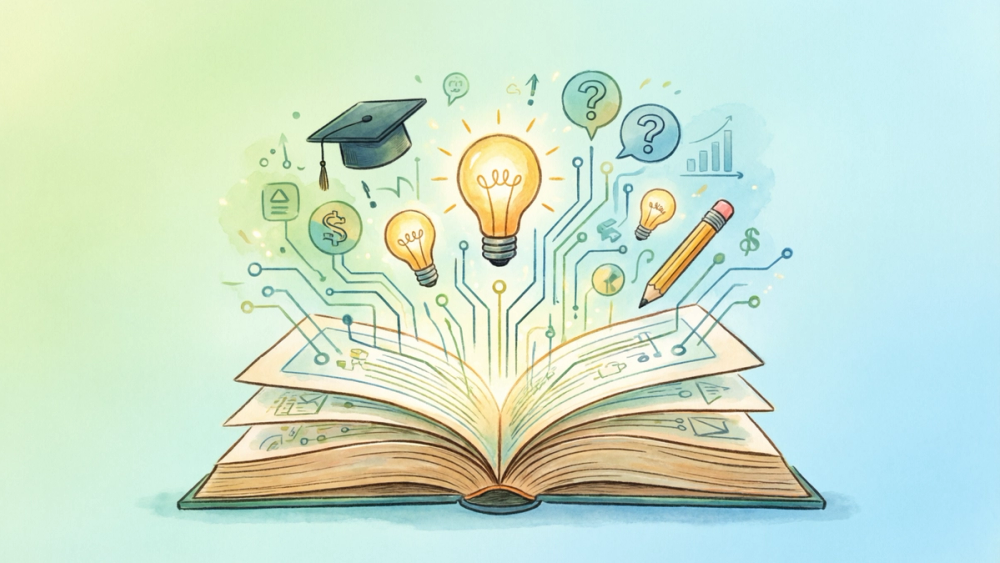
Beyond the debate about AI in classrooms, teachers and students are already using specific tools daily. Here is what is actually working in education.
2026/04/15
Education technology has a long history of promises that underdeliver. Interactive whiteboards were supposed to transform classrooms; mostly they became expensive projector screens. One-to-one laptop programs were supposed to revolutionize learning; largely they moved worksheets from paper to screen. AI in education faces the same skepticism, and rightly so. The question for educators is not whether AI is impressive in demos but whether it changes learning outcomes and reduces friction in ways that actually matter.
The honest answer in 2025 is: some AI tools genuinely help, many are not yet proven, and the implementation context matters enormously. The tools that are demonstrably useful are those that save teachers time on administrative tasks, enable personalized pacing in specific skill-based subjects, and provide students with instant feedback on structured learning tasks. The tools that are less proven are those making broad claims about learning outcomes without rigorous evidence.
MagicSchool is the most widely adopted AI lesson planning tool in K-12 settings. It offers over 60 purpose-built AI tools for educators: lesson plan generators, differentiation assistants that modify content for different reading levels or learning needs, rubric builders, quiz creators, and email drafters for parent communication. Teachers report saving 5-10 hours per week on planning and administrative work—time that can be reallocated to instruction and student support.
Curipod specializes in interactive lesson creation with built-in student engagement features—polls, word clouds, drawing prompts, and peer reflection activities. Teachers can generate a complete interactive lesson from a topic and grade level in under five minutes, then present it directly in class with student participation captured in real time. The tool is particularly popular for social-emotional learning, discussion-based classes, and review sessions.
ChatGPT and Claude are used by experienced teachers as general-purpose lesson planning assistants. Unlike purpose-built tools, they require more prompt sophistication to get useful output—but they are more flexible. A teacher can describe a specific curriculum standard, their students' reading level, available materials, and time constraints, then iterate on the generated plan interactively. The learning curve is higher, but the ceiling is also higher.
Khan Academy's Khanmigo is among the most carefully designed student-facing AI tutors available. It uses Socratic dialogue—asking questions rather than giving answers—to guide students through problems. This approach reinforces learning better than simply providing solutions and is philosophically aligned with how experienced tutors work. Khanmigo is available in Khan Academy for nonprofits at subsidized rates for Title I schools.
Synthesis (the spinoff from Elon Musk's school for SpaceX employees' children) uses AI-mediated collaborative problem-solving games to develop mathematical and systems thinking. Students work through simulations that adapt to their performance level. The approach is genuinely novel—it does not replicate traditional instructional formats but creates new contexts for applied mathematical reasoning. Early outcome data is promising but comes from a relatively select population.
Carnegie Learning's MATHia is a well-researched adaptive math platform that has been in use longer than most AI education tools. Its intelligent tutoring system model tracks student knowledge states at a granular level and sequences problems to target specific misconceptions. Randomized controlled trial evidence supports its effectiveness for middle and high school mathematics—one of the better evidence bases in education technology.
Intelligent tutoring systems (ITS) are the most research-backed category of AI in education. They adapt instruction to the individual learner's knowledge state, providing targeted problems, hints, and feedback based on a model of what the student knows and does not know. The best systems have demonstrated learning gains equivalent to one-on-one human tutoring in controlled studies—a significant finding given that one-on-one tutoring is known to be dramatically more effective than classroom instruction.
The challenge is that effective ITS are domain-specific and expensive to build. Carnegie Learning, Knewton (acquired by Wiley), and Smart Sparrow build ITS for specific subject areas—math, reading, science—where structured knowledge models can be constructed. Generalist AI tutors like Khanmigo or Claude represent a different approach: broader coverage with less deep domain modeling, trading some precision for flexibility.
Grading is one of the most time-consuming parts of teaching, and automated grading for structured assessments—multiple choice, fill-in-the-blank, math problems—has existed for decades. AI has extended automation to more complex tasks: short answer grading, essay scoring, and coding assignment evaluation. Tools like Gradescope use AI to group similar student responses together, allowing teachers to apply feedback to all similar responses at once rather than one at a time.
Essay feedback is the most contested area. Tools like Turnitin's AI writing assistant, Revision Assistant, and EssayGrader provide AI-generated feedback on essay drafts before submission. The feedback is useful for surface-level issues—structure, clarity, argument support—but lacks the nuanced understanding of a teacher who knows the student and the assignment context. The appropriate use is as a first-pass feedback tool to help students revise before teacher review, not as a replacement for teacher feedback.
Turnitin AI Detection has become the most widely deployed tool for detecting AI-generated writing in academic submissions. It uses a model trained on AI-generated and human-written text to produce a percentage score indicating the likelihood of AI authorship. The tool has limitations: false positive rates are higher for non-native English speakers and for certain writing styles that happen to resemble AI output. Turnitin itself recommends that educators treat the score as one data point in a holistic assessment rather than a definitive conclusion.
GPTZero is a standalone AI detection tool that provides more granular analysis—highlighting specific passages most likely to be AI-generated and explaining the features that triggered the flag. It is used by individual educators and institutions that are not in the Turnitin ecosystem. The detection accuracy for current AI models (GPT-4, Claude 3, Gemini) is reasonably high for long-form writing, but degrades significantly for shorter texts and for AI output that has been manually edited.
The broader academic integrity challenge cannot be solved by detection alone. Educators are rethinking assessment design: moving toward process-based assessment (documenting multiple drafts, reflection on revisions), in-class assessments, oral examinations, and project-based learning where the work itself demonstrates understanding beyond what AI can simulate. Detection is a useful tool but treating it as the primary response is fighting the wrong battle.
Students are using AI tools extensively regardless of whether institutions formally endorse them. ChatGPT, Claude, and Perplexity AI are used for research assistance, concept explanation, study guide generation, and problem-solving help. Research assistants like Perplexity AI and Consensus (which searches peer-reviewed literature specifically) are genuinely useful for helping students locate and understand academic sources.
Anki's AI-integrated flashcard generation tools allow students to convert lecture notes or textbook passages into spaced-repetition flashcard decks automatically. Quizlet's Q-Chat creates an AI tutor experience that uses the content from a student's flashcard set to quiz them in a conversational format. Notion AI helps students organize research notes and synthesize information across multiple sources. These tools work best when students understand the underlying learning science—that retrieval practice and spaced repetition are effective strategies, not shortcuts.
Duolingo has integrated AI pervasively into its platform. The Duolingo Max subscription includes Explain My Answer (providing detailed explanations of why a particular response was correct or incorrect) and Roleplay (AI conversation practice with context-aware feedback on grammar and vocabulary). These features address the core limitation of language learning apps: traditional apps could not simulate real conversation.
Speak is a voice-focused language learning app built entirely around AI conversation practice. Users speak into the app in their target language, and the AI provides immediate pronunciation feedback, grammar corrections, and vocabulary suggestions in a conversational format. Early user research shows meaningful improvement in speaking confidence and accuracy for consistent users. The tool is particularly effective for learners who have foundational grammar knowledge but lack opportunity to practice speaking.
AI has created genuine advances in educational accessibility. Automatic captioning in video conferencing and lecture recording tools has made classroom content accessible to deaf and hard-of-hearing students without the logistical complexity of hiring human interpreters for every session. Microsoft Azure's Live Captions and Google's Live Transcribe both achieve accuracy levels sufficient for most classroom contexts.
Text-to-speech tools with natural AI voices—rather than robotic synthesis—have made written content more accessible to students with dyslexia, visual impairments, and reading difficulties. Natural Reader and Speechify use voices that sound genuinely human, making extended listening to textbook content or article assignments a reasonable experience rather than a fatiguing one. Microsoft's Immersive Reader includes a word-by-word highlighting feature alongside TTS that is particularly effective for students with reading processing challenges.
Parent communication is a significant time cost for teachers, particularly in diverse school communities where language barriers exist. MagicSchool's parent communication tools draft translated messages in over 50 languages, allowing teachers to communicate with families in their home language without hiring translators for routine updates. Remind and ClassDojo have integrated AI writing assistance for teachers drafting newsletters, progress updates, and behavioral notes.
Beyond the classroom, AI is reducing administrative burden on school leaders and operations staff. IEP and 504 plan documentation—legally required for students with disabilities—involves substantial writing that is highly structured and template-driven. Tools like Goalbook and Special Ed Tools use AI to draft IEP goals, progress notes, and evaluation reports based on assessment data, which teachers and specialists then review and refine. Schools using these tools report significant time savings for special education staff.
Scheduling, substitute management, and facilities coordination are also being automated in larger districts. PowerSchool and Frontline Education have integrated AI features for substitute placement and absence management. These are not glamorous applications, but they reduce administrative friction significantly for school operations staff.
Schools and universities are at very different points in developing AI policies. Some institutions have banned AI tool use entirely—a policy that is difficult to enforce and may disadvantage students relative to peers at institutions with more permissive approaches. Others have adopted AI-permitted or AI-encouraged approaches that require disclosure and documentation. Most are still developing policies, which creates confusion for students who receive conflicting guidance across different courses.
Effective policies distinguish between use cases rather than treating AI as a monolithic category. Using AI to generate a first draft of an essay without disclosure is different from using AI to check grammar, which is different from using AI as a brainstorming partner, which is different from using AI to understand a complex concept that was not clear from the textbook. Clear, use-case-specific guidance is more practical and educationally defensible than blanket policies.
Survey data from the 2024-2025 academic year shows a complex picture of educator attitudes toward AI. Most teachers believe AI will be an important skill for students to learn (over 85% in most surveys). Fewer believe current AI tools measurably improve learning outcomes (closer to 40%). A majority report using AI tools themselves for at least some teaching preparation tasks. The biggest concerns are academic dishonesty, equity of access, and the risk that AI substitutes for genuine learning effort rather than augmenting it.
Developmental appropriateness matters significantly in AI education tool adoption. Elementary-age students benefit most from AI tools that provide immediate feedback in skill-based learning (reading, math facts, phonics) and from AI-generated interactive content that is engaging and appropriately leveled. They are generally not well-served by open-ended AI chat tools, which require literacy and critical thinking skills to use productively.
Middle and high school students can engage with AI tools more productively for research, writing assistance, and study aid purposes when teachers explicitly teach the skills to evaluate AI output critically—checking factual claims, recognizing bias, and understanding the difference between AI-generated and human-expert knowledge. College and professional education contexts are most suitable for expansive AI tool use, paired with explicit frameworks for appropriate disclosure and citation.
Perhaps the most important function of education in the current moment is preparing students to work effectively and ethically alongside AI systems. This requires that schools develop AI literacy as an explicit curricular goal: students should understand how AI systems are trained and where their outputs are reliable vs unreliable, how to use AI tools as research and drafting assistance while maintaining original thinking, the ethical dimensions of AI authorship and attribution, and how AI is changing specific professional fields students may enter.
The institutions doing this best are not treating AI literacy as a separate add-on course but integrating it across subjects—having students use AI tools with reflection in English class, evaluate AI-generated claims in science, explore algorithmic decision-making in social studies. This integrated approach mirrors how AI actually functions in professional and civic life: not as a separate domain but as a layer on top of every domain.