Stay Updated
Get the best new AI tools in your inbox
Weekly roundup of the latest AI tools, trends, and tips — no spam, unsubscribe anytime
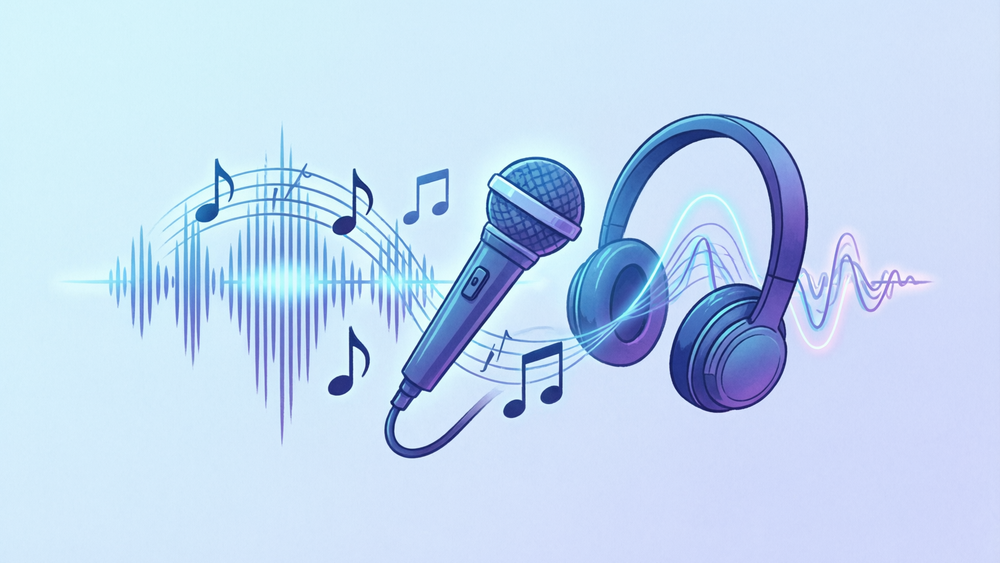
AI audio tools now handle transcription with near-human accuracy, clone voices from short samples, and generate original music. Here is what each category does well and where caution is warranted.
2026/04/07
Audio has quietly become one of the most transformed domains in AI. What once required a professional studio setup, a sound engineer, and hours of editing can now be accomplished in minutes with the right tools. Whether you need to transcribe a podcast, clone a voice for your brand, or generate original music for a video, there is an AI tool purpose-built for that task.
The pace of change is striking. OpenAI's Whisper, released in 2022, immediately outperformed most commercial transcription services on accuracy. ElevenLabs launched voice cloning that sounded indistinguishable from real recordings. Suno and Udio began producing complete songs from text prompts. Understanding which tools to use—and when—is now a genuine competitive advantage.
Transcription is the most mature and widely deployed category of AI audio tools. The leading options each have distinct strengths. OpenAI's Whisper is an open-source model that you can run locally or via API. It supports over 90 languages, handles background noise reasonably well, and is free if you self-host. Its main limitation is that it is not real-time—it processes completed audio files rather than live streams.
Otter.ai is the dominant choice for meeting transcription. It integrates with Zoom, Google Meet, and Microsoft Teams, identifies different speakers, and generates automated summaries with action items. The free tier is generous for light use. Its transcription accuracy is strong for clear American English but degrades noticeably with heavy accents or multiple overlapping speakers.
Rev AI and Deepgram occupy the professional end of the market. Both offer real-time streaming transcription via API, making them suitable for live captioning, call center analytics, and voice-controlled applications. Deepgram's Nova-2 model achieves word error rates below 5% on clean audio and handles diverse accents better than most competitors. Rev AI offers a human review option where trained transcriptionists check AI output, which is worth the premium for legal or medical transcription.
Accuracy benchmarks are deceptive if you only look at headline numbers. A model that achieves 95% accuracy on American English may drop to 80% on Scottish English, 75% on Indian English, and 60% on heavily accented non-native speakers. Before committing to a transcription tool, test it with audio samples that match your actual use case—ideally from your own team or customer base.
For non-English languages, Whisper large-v3 consistently outperforms specialized commercial tools for major European languages. For Arabic, Hindi, Mandarin, and Japanese, Deepgram and AssemblyAI have invested more in training data and tend to perform better in production settings. AssemblyAI in particular has strong support for code-switching—audio where speakers mix languages mid-sentence—which is common in multilingual workplaces.
The choice between real-time and batch transcription depends entirely on your use case. Real-time transcription is essential for live captions, voice interfaces, and customer service monitoring. It requires streaming infrastructure and accepts slightly lower accuracy as a tradeoff for speed. Deepgram and AssemblyAI both offer sub-300ms latency, which is sufficient for most applications.
Batch transcription—where you upload a completed audio file and receive results back—allows models to use context from the full audio, yielding better accuracy. For podcasts, recorded meetings, video content, and interviews, batch transcription is almost always the right choice. Costs are also lower: most providers charge roughly $0.20 to $0.50 per hour of audio for batch vs $0.60 to $1.50 for real-time.
Voice cloning allows you to create a synthetic version of a specific person's voice that can then speak any text. The technology has advanced dramatically: modern systems need as little as 30 seconds of source audio to produce a convincing clone, and the best require only a few minutes of clean recording.
ElevenLabs is the market leader for quality. Its voice cloning produces results that are difficult to distinguish from the original speaker, with accurate emotional range, pacing, and intonation. It supports 29 languages. Professional Voice Clone (PVC) plans allow instant cloning from uploaded samples. The technology is primarily used for audiobook narration, video dubbing, and consistent brand voice in content production.
Resemble AI differentiates itself with real-time voice cloning and emotion controls. You can adjust the emotional intensity of output—useful for generating customer service audio that needs to sound warm and empathetic rather than robotic. Play.ht offers a large library of pre-built voices alongside cloning, which is useful when you need multiple distinct voices for a project without source recordings for each.
Voice cloning raises significant ethical and legal questions that practitioners need to take seriously. Using someone's voice without consent—even for seemingly benign purposes—violates their autonomy and can cause real harm. Several high-profile cases have involved deepfake audio used for fraud, political manipulation, and harassment.
Responsible use means obtaining explicit written consent from anyone whose voice you clone, maintaining secure storage of voice models, and disclosing to audiences when synthetic voices are used. Most commercial providers now require consent documentation before activating professional cloning. US states are beginning to legislate voice consent, and the EU AI Act includes voice biometrics in its high-risk category. Businesses should establish clear internal policies before adopting voice cloning at scale.
AI music generation has moved from curiosity to practical tool in under two years. Suno v4 can produce a complete, polished song with vocals, instrumentation, and mastering from a text prompt in under 60 seconds. The output quality is genuinely impressive for background music, content scoring, and prototype demos—though it still struggles with complex arrangements and lyric coherence in longer songs.
Udio positions itself as more musically sophisticated, with better handling of genre-specific conventions and more consistent lyric quality. It allows stem separation, letting you download individual tracks for guitar, drums, and vocals separately. AIVA focuses on instrumental scoring, particularly classical, cinematic, and orchestral music. It is widely used by indie game developers and YouTubers who need royalty-free original scores without hiring a composer.
The copyright situation for AI-generated music is still evolving. Most platforms grant you rights to use the music commercially under their subscription plans, but the underlying training data ownership remains legally contested. For high-stakes commercial use—advertising, film, major brand campaigns—consult a music lawyer and consider platforms that offer explicit commercial licenses with clearer terms.
Podcasting has seen a wave of AI tooling that covers the entire production pipeline. Descript allows you to edit audio by editing a text transcript—delete a word from the transcript and it disappears from the audio. Its Studio Sound feature applies broadcast-quality enhancement to recordings made on laptop microphones. Overdub uses voice cloning to insert corrected words seamlessly.
Adobe Podcast (now part of Adobe Creative Cloud) offers similar enhancement capabilities with Adobe's polish. Its Enhance Speech tool is widely regarded as the best single-click audio enhancement available, removing room echo and background noise while preserving voice naturalness. Riverside.fm handles remote recording with lossless local capture from each participant, eliminating the quality degradation of recording Zoom calls directly.
Background noise removal has become commoditized. Krisp and NVIDIA RTX Voice both run in real-time on your device, filtering out keyboard sounds, air conditioning, and street noise during calls. Krisp works on any microphone via a virtual audio device; RTX Voice requires an NVIDIA GPU but achieves slightly better results on complex noise environments.
For post-production cleaning, iZotope RX remains the professional standard. Its AI-powered tools—including dialogue isolation, de-reverb, and spectral repair—handle damage that simpler tools cannot. The price is significant (RX 11 Standard is around $400), but for video production studios, podcast networks, or any organization producing regular audio content, it pays for itself quickly in reduced editing time.
Media organizations use AI audio primarily for transcription and translation. Broadcast networks use automated transcription to generate captions at scale, while journalism organizations use it to convert interview recordings into searchable, quotable text. Dubbing houses are beginning to integrate voice cloning into localization workflows, dramatically reducing the cost of adapting content for multiple language markets.
In education, AI audio tools enable accessibility at scale. Automatic captioning makes video lectures accessible to deaf and hard-of-hearing students without manual effort. Text-to-speech with natural voices allows students with dyslexia to consume written content as audio. Language learning platforms like Duolingo and Speak use voice cloning and synthesis to provide native-quality conversation practice.
Healthcare and legal are high-value but high-stakes environments. Medical transcription software like Nuance DAX and DeepScribe assist clinicians in documenting patient encounters in real time, reducing documentation time by 50% or more in clinical trials. Legal transcription requires high accuracy and often human review; services like Rev and 3Play Media offer hybrid human-AI workflows that meet courtroom admissibility standards.
Pricing varies enormously across the category. Whisper via OpenAI API costs $0.006 per minute of audio—essentially trivial. Otter.ai's Pro plan is $10/month for individuals. Deepgram's pay-as-you-go starts at $0.0043 per minute. ElevenLabs ranges from $5/month for hobbyists to $330/month for professionals with high-volume cloning. Suno's paid plans start at $8/month for commercial use. Adobe Podcast is included in Creative Cloud subscriptions.
For most teams getting started, the practical approach is to use free tiers to validate use cases before committing. Whisper's free self-hosted option is ideal for developers who want to experiment without API costs. Otter.ai's free tier handles 600 minutes per month, which is sufficient for a team of 5-10 people with moderate meeting loads.
Start by identifying your primary use case. If you need transcription for meetings, Otter.ai or Fireflies.ai are the most turnkey options. If you are building a product that requires transcription via API, evaluate Deepgram and AssemblyAI side-by-side with your own audio samples. If you are creating audio content and want to reduce editing time, Descript is the most complete single-platform solution.
Voice cloning is worth the investment if you produce high volumes of narrated content—training videos, e-learning courses, product demos—where recording reshoots are expensive. Music generation tools are immediately practical for anyone who needs background music for video content and does not want to deal with licensing libraries. Start with Suno's free tier to assess quality fit before paying.
The trajectory points toward real-time multimodal audio AI—systems that can listen to a conversation, understand its context, and respond with synthesized speech in under 100ms with natural emotional cadence. OpenAI's GPT-4o demonstrated this capability in controlled demos. As these models become productized, they will enable a new generation of voice interfaces that feel genuinely conversational rather than command-response.
Music generation will converge toward systems that can collaborate with human musicians in real time—suggesting chord progressions, generating backing tracks in the artist's style, and adapting dynamically to live performance. The tools are not there yet, but the pace of improvement suggests they will be within 2-3 years. For practitioners, the best investment now is developing fluency with today's tools while staying curious about what's emerging.